
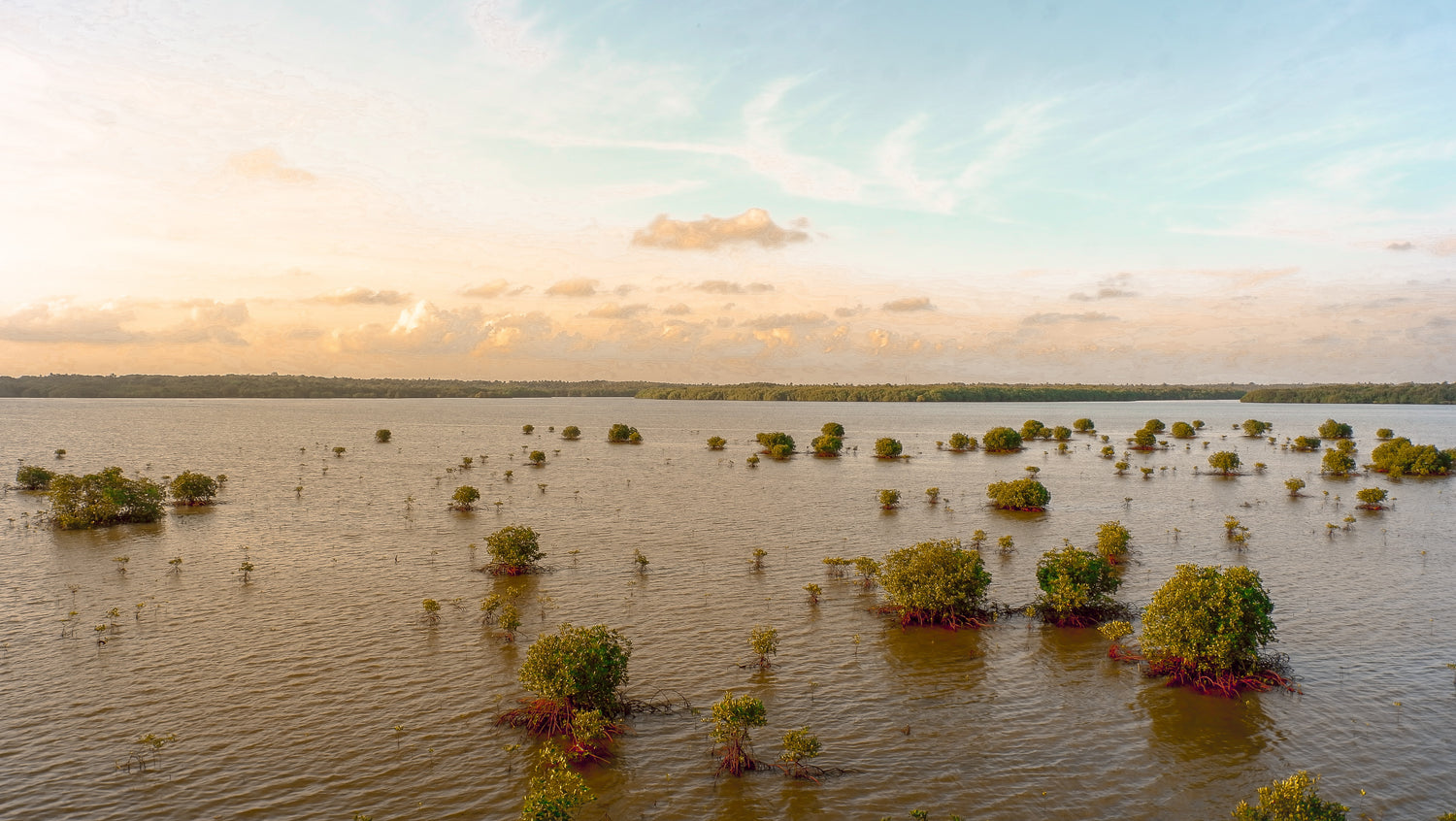
Why do we plant trees in Bangladesh?
The production of a garment results in a release of CO2. The last few years have made it clear how harmful this is to our environment. At higher concentrations, it can lead to warming of the Earth's climate. This is why the 2-degree target was set a few years ago - our Earth may warm by no more than 2 degrees. Sounds trivial - but even that has immense effects.
For this reason, we have decided to plant a tree for every order. Trees are true masters in compensating CO2 because they bind carbon dioxide for their own growth.
Our partner Hudara supports us here with knowledge and commitment. Hudara carries out the planting of mangrove trees in Bangladesh for us, because mangroves are about 5 times more efficient than tropical rainforests and compensate on average one ton of CO2 over a period of 25 years. They are therefore considered not only a very efficient system of CO2 compensation but also a socio-ecological wonder.

Bangladesh is a country that is very strongly affected by climate change. It has a high population density on a small area. The country often struggles with flooding, heavy monsoon rains, soil salinization, and other problems - and this directly affects a large number of people. Mangrove trees are a very helpful tool here: they are planted along the coastlines and secure them through rooting. This can prevent flooding. Mangroves also greatly increase the fish population. This in turn supports the country's main economic sector: fishing.
Hudara continues to support social projects in the country. The wood of the mangrove tree is valuable and is quickly cut down. It is important here to create a change in people's minds and to show them that mangroves fulfill important functions.
We are therefore very pleased to be able to support this project.



Leave a comment
This site is protected by hCaptcha and the hCaptcha Privacy Policy and Terms of Service apply.